
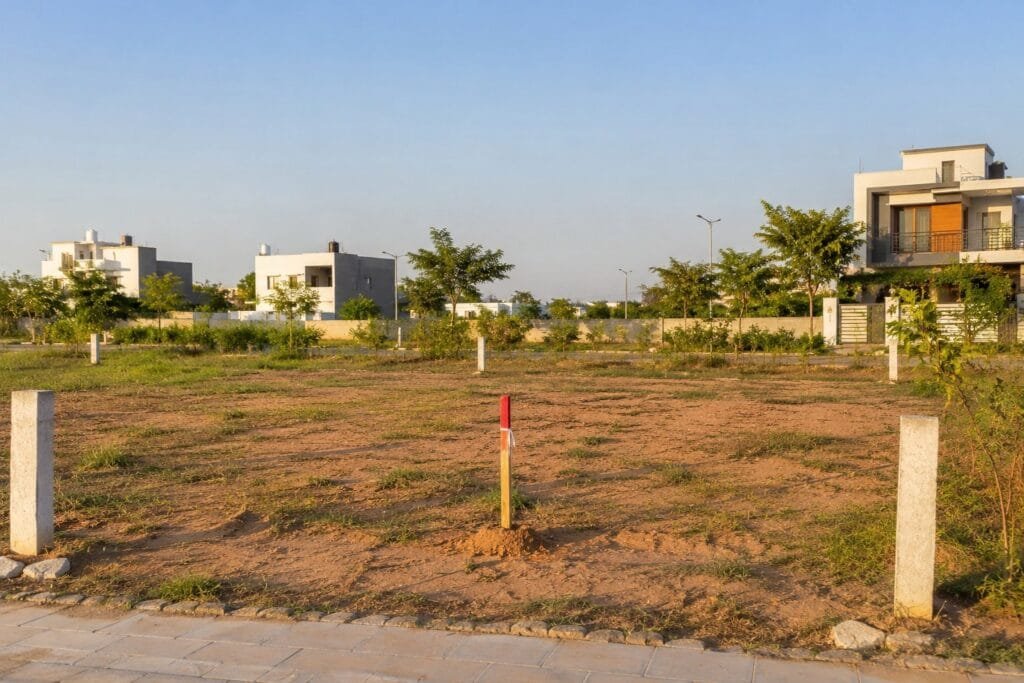
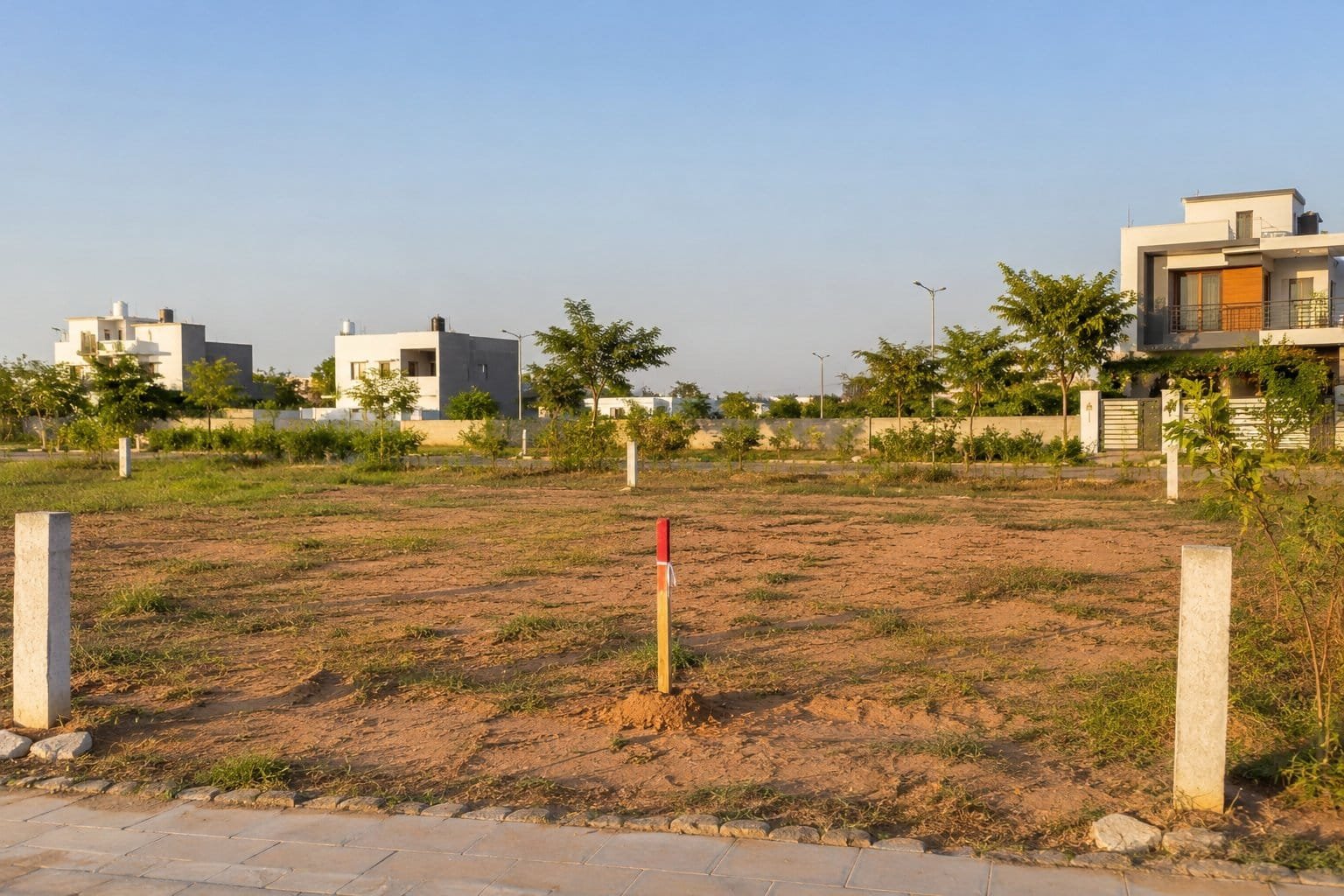
Buying a builder plot in Noida Extension is not like buying a flat in a registered society. A flat usually comes with an occupancy certificate and a registered society behind it. A builder plot may be a piece of agricultural land carved up and sold as plots. Some of these plots are perfectly legal. Some are not. The difference shows up only in documents, so you have to check before you pay any token money.
We build homes in Greater Noida, Noida Extension, Jewar and along the Yamuna Expressway, and we have seen families get stuck with plots that could never be registered. This article explains, step by step, how to check a legal builder plot in Noida Extension before you commit. No legal advice here, just the practical checklist we share with our own clients.
Why Noida Extension plots need extra checking
Noida Extension falls mostly under the Greater Noida Industrial Development Authority, also called GNIDA. Much of the land here was originally agricultural, notified under land acquisition laws and later released, converted, or licensed for residential use. A builder or landowner may subdivide a large chunk into plots and sell them. The problem is simple. If the land was never legally converted for residential use, or the subdivision was never approved, the registry can be refused at the tehsil office. You lose the plot and recovering your money can take years in court.
So the extra checking is about two things. First, is the land legally usable for a house? Second, can the specific plot you are buying actually be registered in your name? Both questions are answered by paper, not by the seller’s word or a fancy brochure.
Documents to demand from the seller
Ask for these papers before you discuss price. A genuine seller will have them ready. A seller who says “sab baad mein de denge” is already a warning sign.
- Registry or sale deed chain: every sale deed from the original allotment down to the current seller.
- Khasra and khatauni: the revenue record showing the land’s khasra number, area and recorded owner.
- Authority allotment or lease deed: if the land was allotted or leased by GNIDA or any authority, that document must exist.
- Land use conversion order: the order converting agricultural land to residential or abadi use.
- Licensed colony approval: if it is a builder-layout colony, ask for the layout plan approval and licence number.
- Mutation (dakhil kharij) records: proof that each past sale was mutated in revenue records.
- No-dues and map approvals: development charges receipt, approved layout map, and any building bye-law conditions.
- Encumbrance check: ask whether the plot is mortgaged to a bank or under any court dispute.
Get photocopies or scans of everything. You will need them for your own lawyer and for the sub-registrar’s office.
How to check land use and authority records
Visit the authority office
Do not rely only on the seller’s folder. Go to the GNIDA office in Greater Noida and ask for the land use status of the khasra number. The staff can tell you if the land is residential, agricultural, green belt, or under any acquisition or reservation. For plots near Noida Extension, also check whether the land falls in a notified scheme or sector plan. This one visit can save you from buying a plot that sits on a proposed road or a green belt.
Check online records
Uttar Pradesh land records are online. Use the UP Bhulekh portal for khasra and khatauni details, and the UP revenue department’s e-registration portal to search past registered deeds by seller name, year and tehsil. These records are free or very low cost. They show the recorded area, the recorded owner and past transactions. If the seller’s name on the deed does not match the name in Bhulekh, stop and ask questions.
Match the plot on the layout map
Lay the approved layout plan over the actual site. Check the plot number, the plot size, the road width, and the setbacks shown on the map. Sometimes what is sold as a 100 sq m corner plot is actually a narrowed piece next to a drain. Walk the plot with the map in hand.
Verifying chain of registry and khasra details
The chain matters as much as the last deed. Start from the oldest document. If the land was acquired by the authority and then released under Section 21 or abadi policy, there will be a release order. Read it. Some release orders allow only specific use or only specific persons, such as original landowners. If your seller is the fourth buyer and the release order allowed sale only to the original owner’s family, the chain is broken and your registry is at risk.
For khasra details, check three things. One, the khasra number on the deed matches the number in Bhulekh. Two, the area in the deed is not more than the area in the revenue record. Three, mutation has been done after every sale. A missing mutation is fixable, but fix it before you pay, not after.
A simple verification checklist
- Khasra number on deed matches Bhulekh record
- Seller’s name matches revenue record and Aadhaar
- Land use is residential in authority records
- Layout plan approved and plot number exists on it
- Full registry chain available, no gaps
- Mutation done for every past transaction
- No bank mortgage or court case on the land
- No acquisition notice, scheme reservation or road widening on the plot
- Physical possession clear, no boundary dispute with neighbours
- Development charges and any authority dues paid
Red flags that signal an illegal plot
- Price far below the going rate for the area, with pressure to pay cash fast.
- Seller cannot produce the original registry, only photocopies.
- “Registry baad mein ho jayegi” or promises of registry after some approval “comes”.
- Plot shown on a hand-drawn map instead of an approved layout plan.
- Land shown as agricultural in records but described as residential by the seller.
- Seller is not the recorded owner and claims to be selling on someone’s behalf without a registered power of attorney.
- Part of the colony already has houses, but nobody has a registry. Do not take this as proof of legality. Many illegal colonies in the region have built houses that later faced demolition or regularisation fees.
- Any mention of court case, kabza dispute, or bank loan on the parent land.
Any one of these is enough reason to pause. Two or more together, walk away.
Role of lawyer and authority office visit
A property lawyer in Uttar Pradesh will typically charge a few thousand rupees for a title verification opinion. That fee is small against the price of a plot. Give the lawyer the complete document chain and ask for a written opinion on whether the title is clear and marketable. Ask specifically about the land use and the release or conversion order.
Along with the lawyer, make the authority office visit yourself. Officers at the GNIDA office in Greater Noida deal with these queries daily. Ask for the master plan land use of the khasra, any pending acquisition, and whether the builder layout has approval. Take notes and keep the receipt of any paid inquiry.
One more honest point. If your plan is to build a house on the plot after buying, get the building bye-laws checked at the same time. Height limits, ground coverage and setback rules differ by road width and plot size. We provide architecture drawings with drawings checked against the bye-laws before submission, so the map sanction process does not stall later.
Safe payment structure with milestones
Never pay the full amount in one go on day one. A safe structure looks like this:
| Step | What you do | Payment |
|---|---|---|
| 1. Initial interest | Collect copies of all documents | Nothing |
| 2. Verification | Lawyer opinion plus authority office check | Lawyer fee only |
| 3. Agreement to sell | Written agreement with clear terms and last date for registry | Small token, typically 5 to 10 percent |
| 4. Registry | Registered sale deed at sub-registrar office with witness and bank draft | Major balance payment at registry |
| 5. After registry | Mutation in your name, possession letter, boundary demarcation | Any small balance only after possession |
Keep every payment through bank transfer or draft, never cash. A bank trail is your proof if anything goes wrong. Also insist that the agreement to sell clearly mentions the plot number, khasra number, area and the exact amount, and that full payment happens only at the registrar’s office on the day of registry.
Once the plot is yours
After registry and mutation, the next step is planning the house. If you want a working idea of construction cost before meeting anyone, our free home construction cost calculator gives an item-by-item estimate. Grey structure work starts from Rs 1,100 per sq ft as the calculator base rate, with Rs 100 per sq ft extra if the house has two habitable floors or fewer, and basement work at Rs 1,500 per sq ft. Turnkey construction with material starts at Rs 1,650 per sq ft for the Basic package on our 2026 price list, going up to Rs 2,400-2,800+ per sq ft for luxury villas. GST is extra in every case, and the final quotation always comes after a site visit.
If you would like, you can also read more about our construction work in Greater Noida and the areas we serve, including Noida Extension and Jewar. And if you already own a plot and want a second opinion on what can legally be built on it, we are happy to look at your layout and bye-law limits during a site visit.
Call or WhatsApp us at +91 95825 81238 if you want to talk about your plot or your house plan. We work across Greater Noida, Noida, Noida Extension, Jewar and the Yamuna Expressway belt. A short conversation costs nothing.
Frequently Asked Questions
Be careful. A registered power of attorney executed in favour of a named person can be valid, but a chain of unregistered agreements plus power of attorney is common in illegal colonies and courts have not treated them as full transfers. Insist on a registered sale deed in your own name. If the seller offers only power of attorney, get a lawyer's opinion before paying anything.
Banks lend only on plots with clear title and approved layout, and often only in approved colonies or licensed developments. If a bank refuses your loan application, treat that as useful information about the plot, not just a banking formality. Many buyers skip the loan to avoid scrutiny, and that is exactly how problem plots get sold.
The khasra number is the revenue record number of the parent land parcel, recorded in Bhulekh. The plot number is the number given to your individual plot in the approved layout of the colony. Both must be traceable to each other. The plot you buy should sit inside the khasra mentioned in the deed, with an approved layout map showing exactly where your plot falls.
No. In several colonies around Noida Extension, dozens of houses stand on land that was never converted or approved. Construction without approval can face regularisation charges, map rejection, or worse, action under demolition orders in reserved areas. Verify land use and layout approval independently at the authority office, whatever your neighbours have built.
Planning construction or interiors in Greater Noida?
Get expert guidance, clear budgeting, and site execution support from Aarna Constructions & Interiors.