
Epoxy Flooring: Types, Liquid Granite, Liquid Terrazzo and Where It Works
Quick answer: Epoxy flooring is a seamless floor made by mixing resin with a hardener and laying it over a dry, prepared concrete base. It suits parking, factories, warehouses, showrooms and indoor home rooms, but not open sun or damp slabs without a moisture barrier. "Liquid granite" and "liquid terrazzo" are trade names for decorative resin floors, and Aarna prices epoxy work only after a site visit and selection.
Get a site visit and quoteWhatsApp +91 95825 81238
What is epoxy flooring?
Epoxy flooring is a floor made by mixing a liquid resin with a hardener and spreading it over a prepared concrete or screed base. The two parts react and set into a hard, seamless plastic layer that is bonded to the concrete below. There are no tiles and no joints. The result can be a thin rolled-on coat or a thicker poured layer that levels itself.
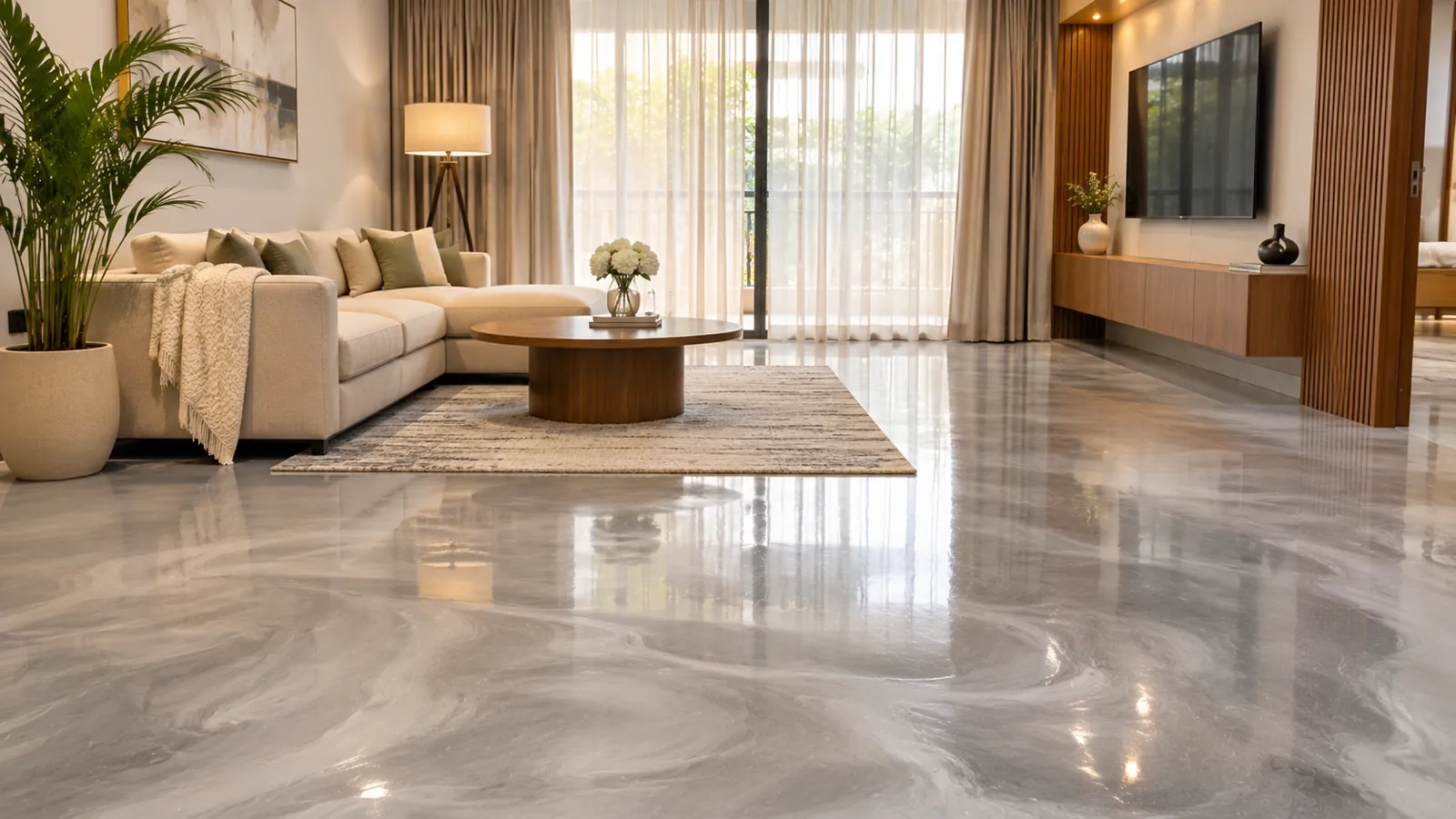
The floor is only as good as the base under it. Epoxy does not hide a weak, damp or cracked slab. It shows every problem within months. That is why most of the work, and most of the failures, happen before the resin is even opened.
Types of epoxy flooring
Epoxy coating (roller coat)
A thin system, usually a primer plus one or two coats, rolled onto the concrete. It seals dust, makes cleaning easy and gives a plain colour. Used in parking areas, store rooms and light-duty warehouses. It is thin, so it wears faster under heavy trolleys.
Self-levelling epoxy
A thicker mix poured on the floor and spread with a trowel and spiked roller. It flows into a flat, glossy, joint-free surface. Used in factories, showrooms, clinics, labs and food units where hygiene and a flat floor matter.
Metallic epoxy
Self-levelling epoxy with metallic pigments that are moved by hand while wet. It gives a swirling, marble-like or lava-like look. No two floors look the same. This is the type most often sold as a decorative floor for homes and showrooms.
3D epoxy flooring
A 3D epoxy floor uses a large printed image (sea water, pebbles, clouds) laid on the base and covered with a clear resin layer. The clear layer gives depth. It looks striking in photos, but a printed image can date quickly and cannot be changed without redoing the floor. Think carefully before you put one in a living room you will use for many years.
Anti-static and industrial epoxy
Electronics units, server rooms and some pharma areas need floors that drain static charge. Anti-static (ESD) epoxy has conductive material and is connected to earthing. Industrial grades may also be chemical-resistant or have sand mixed into the top coat for grip. These are specified by the factory's own standards.
Liquid granite flooring and liquid terrazzo flooring: what the names really mean
Liquid granite flooring is a trade name, not a stone. It usually means a decorative resin floor, often metallic epoxy or a resin with coloured flakes or chips, made to look like polished granite. There is no granite slab in it. Ask the seller what the layer is made of, how thick it is and what the top coat is.
Liquid terrazzo flooring can mean two different things. Real terrazzo is chips of marble, stone or glass set in a binder, then ground and polished. Epoxy terrazzo uses resin as that binder, poured on site and ground flat, so the chips run through the full thickness. Some sellers use the same name for a thin flake coat that only looks like terrazzo on the surface. The two are very different in thickness, wear and repair. Get the system name and layer thickness written in the quote.
Where an epoxy floor suits, and where it does not
| Space | Good fit? | What to watch |
|---|---|---|
| Basement and stilt parking | Yes | Tyre marks, oil, water from cars; use an anti-skid top coat |
| Factory and warehouse | Yes | Forklifts and racks; thickness must match the traffic |
| Showroom and clinic | Yes | Scratches from furniture; plan a protective top coat |
| Kitchen | With care | Hot vessels and spills; the floor can be slippery when wet |
| Home living room | With care | Seamless and modern; scratches and dull patches show on gloss |
| Open terrace or balcony in full sun | Usually no | Sunlight makes standard epoxy turn yellow and chalky |
| Ground floor slab with damp | No, unless fixed | Moisture from below lifts the coat and makes bubbles |
Epoxy flooring for home use works best indoors, on a dry, level and well-cured slab. Many home owners try it in one room or the basement first, then decide on the rest of the house.
Base preparation: the step that decides the result
- Check moisture. Damp slabs are the main reason epoxy peels. A simple check is to tape a plastic sheet flat on the floor overnight; if the underside is wet or the concrete darkens, moisture is coming up. A meter reading is better. A damp slab needs a moisture-barrier primer or must be left to dry.
- Let new concrete cure. Fresh concrete still holds water. New slabs and screeds need their full curing time before any resin goes on.
- Repair cracks and holes. Cracks are opened, filled with a suitable filler and ground flat. Moving cracks will come back through the epoxy, so find their cause first.
- Grind the surface. The weak top layer, old paint, oil and dust are removed by diamond grinding or shot blasting. Epoxy needs an open, rough surface to grip.
- Level and clean. Low spots are filled, the floor is vacuumed, and the primer goes on soon after.
Laying epoxy over old tiles or marble is possible only with special preparation and is often not worth it. In many homes the tiles come out first and a proper screed is made.
Epoxy vs vitrified tiles vs marble
| Point | Epoxy floor | Vitrified tiles | Marble |
|---|---|---|---|
| Joints | None, seamless | Grout line at every tile | Joints, can be polished nearly invisible |
| Durability | Good on a sound base; gloss scratches | Very hard surface; edges can chip | Softer; scratches and etches from acids |
| Stains | Resists most spills when sealed | Resists most stains | Absorbs oil, tea and lemon if not sealed |
| Repair | Patches often show; a whole area may need recoating | Replace a broken tile if spares are kept | Grind and re-polish |
| Look | Plain, metallic, flake or 3D; modern | Huge range of designs and sizes | Natural stone, each slab unique |
| Sunlight | Standard epoxy yellows outdoors | Fine | Fine, can weather |
| Suits best | Parking, factory, showroom, feature rooms | Most homes and flats | Living rooms, stairs, premium homes |
For a full look at the two common home options, read our guide to vitrified tiles vs marble. For more floor types with photos, see these flooring design ideas.
Epoxy flooring cost and price: how it is worked out
People search for one epoxy flooring cost or epoxy flooring price per sq ft, but there is no single honest number. The price changes with the system (coating, self-levelling, metallic, 3D, ESD), the layer thickness, the resin brand, the condition of the base, the area and the top coat. A 3D or metallic floor in a living room and a plain coating in a parking area are completely different jobs.
At Aarna we do not quote epoxy floors from a fixed rate. We check the slab, test for moisture, agree the system and colour with you, and then give a written quote. GST is extra.
For comparison, our tile fixing labour is Rs 70 per sq ft with cement, and Rs 80, Rs 100 or Rs 140 per sq ft with tile adhesive (three grades). Tiles are bought separately. Removing old tiles and plaster is Rs 20 per sq ft. See all our working rates on the Aarna 2026 rate card and our tile work service.
When you compare epoxy quotes, ask each seller:
- Which system, and how many layers: primer, body coat, top coat?
- What is the total thickness in mm?
- Are base grinding and crack repair included?
- Is a moisture test done, and what happens if the slab is damp?
- Is the top coat UV-stable and scratch-resistant?
- How long before light foot traffic and before full use?
Common epoxy floor mistakes
- Skipping the moisture check on ground floors and basements. Bubbles and peeling follow.
- Coating over dust and oil instead of grinding. The coat lifts in patches.
- Using standard epoxy in the sun on terraces, balconies or near large glass doors. It turns yellow.
- Choosing high gloss for a busy home with pets, kids or heavy chairs. Every scratch shows. A satin or matt top coat hides wear better.
- No anti-skid finish in kitchens, ramps and parking. Smooth epoxy is slippery when wet.
- Mixing too much at once. Epoxy has a limited working time; a rushed pour leaves lines and lumps.
- Walking on it too early. Follow the curing time the system needs before use.
- Buying a name, not a system. "Liquid granite" or "liquid terrazzo" on a quote means nothing without the product and thickness.
Planning an epoxy floor in Greater Noida or Noida?
Aarna Constructions & Interiors has worked in Greater Noida, Noida, Noida Extension, Jewar and along the Yamuna Expressway since 2017, with 200+ projects since 2017. For a parking, showroom or factory floor, see our commercial construction work. For a home, we help you weigh epoxy against tiles or marble room by room. Contact Aarna for a site visit, or call or WhatsApp +91 95825 81238. Timelines are given in writing with the quote.
Common questions
What is the epoxy flooring cost per sq ft in India?
There is no single rate, because cost depends on the system, thickness, resin brand, base condition and area. A thin parking coat and a metallic or 3D home floor are very different jobs. Aarna prices epoxy floors after a site visit and moisture check, with GST extra.
Is epoxy flooring good for home use?
Yes, indoors on a dry, level and well-cured slab it gives a seamless, easy-to-clean floor. It can scratch, and gloss finishes show wear, so a satin top coat suits busy homes. Avoid it in rooms with strong direct sun or a damp slab.
Is liquid granite flooring real granite?
No. Liquid granite is a trade name for a decorative resin floor, often metallic epoxy or a resin with flakes, made to look like granite. Ask the seller for the product name, layer thickness and top coat in writing.
What is the difference between liquid terrazzo and normal terrazzo?
Traditional terrazzo is stone or glass chips set in cement, ground and polished. Epoxy terrazzo uses resin as the binder and is also ground flat. Some sellers use the name liquid terrazzo for a thin flake coat that only looks similar, so check what is actually being laid.
Can epoxy be applied over existing tiles or marble?
It is possible with special grinding and primers, but joints, hollow tiles and loose areas often show through or crack later. In most homes it is better to remove the tiles and lay a proper screed first. A site check shows which is right for your floor.
Does epoxy flooring turn yellow?
Standard epoxy can yellow and chalk when exposed to sunlight. That is why it is not advised for open terraces or balconies. Indoors, a UV-stable top coat helps keep the colour, especially near large windows.