
Vitrified tiles vs marble — which is best for your Greater Noida home (2026)
Flooring is a 20-year decision that affects daily life. Vitrified tiles and marble are the two premium choices for Indian homes. Both look spectacular in a showroom. In real Greater Noida / Noida homes, the difference becomes clear. This guide compares them honestly.
Quick comparison
| Parameter | Vitrified tiles | Marble |
|---|---|---|
| Cost (Rs/sqft, 2026) | 40-120 | 80-500+ |
| Installation cost (Rs/sqft) | 15-25 | 25-50 |
| Hardness | Very hard (PEI 5) | Moderate |
| Stain resistance | Excellent | Poor (porous) |
| Maintenance | Low (daily mop) | High (annual polish, sealing) |
| Heat tolerance | Excellent | Excellent |
| Slip resistance | Good (matte); poor (glossy) | Moderate when polished |
| Cold feel | Moderate | Very cold |
| Variety | Vast (thousands of designs) | Pattern-limited per slab |
| Lifetime | 15-20 years | 30+ years (if maintained) |
| Radioactive | No | Slight (generally safe) |
Vitrified tiles — deep dive
What are vitrified tiles?
Engineered ceramic tiles fired at high temperature with added silica, giving them a vitreous (glass-like) surface. Made in precise sizes with consistent patterns.
Types
- Glazed vitrified tiles (GVT): printed pattern, glazed surface. Rs 40-80/sqft. Most common.
- Polished glazed vitrified tiles (PGVT): high-gloss finish. Rs 60-120/sqft.
- Double-charge vitrified tiles: pattern embedded 3-4mm deep. Better durability. Rs 80-140/sqft.
- Full-body vitrified tiles: pattern runs throughout thickness. Chips don’t show. Rs 90-160/sqft.
- Large-format tiles: 60×60, 80×80, 100×100 cm. Premium look. Rs 80-200/sqft.
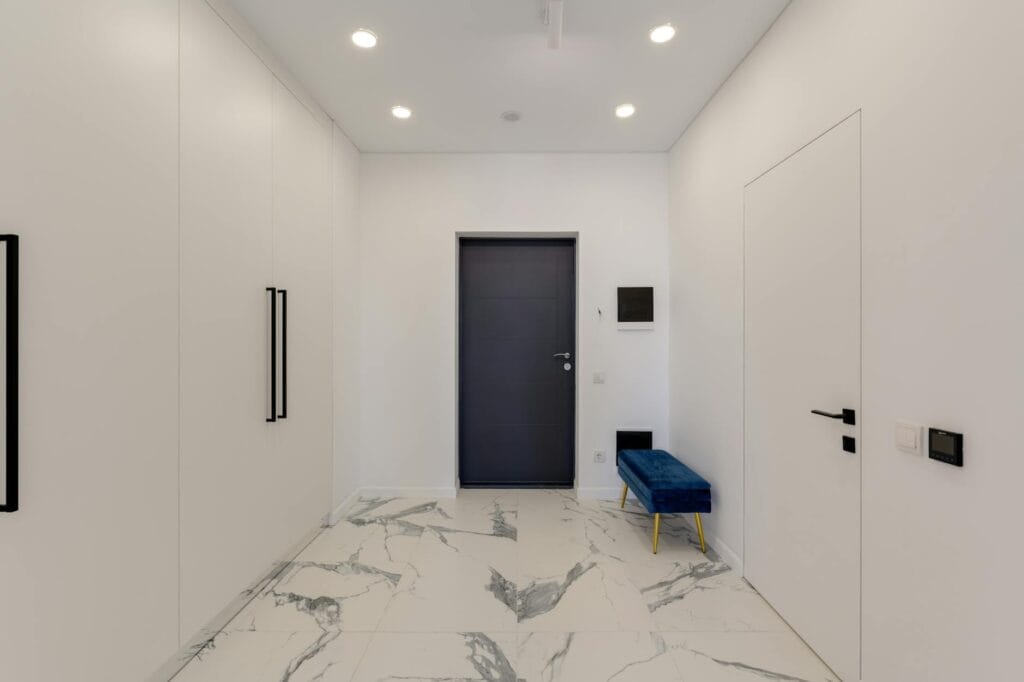
- Marble-look vitrified: realistic marble pattern printed on tile. Rs 70-150/sqft.
- Wooden-look vitrified: realistic wood grain printed. Rs 80-150/sqft.
Popular brands
Kajaria, Somany, Johnson, Orient Bell, Asian Granito, RAK, Nitco, Cera — all available in Greater Noida markets.
Pros
- Lower cost than marble
- Extremely hard-wearing (PEI 5 rating) — scratches and dents rare
- Non-porous — stains wipe off easily
- Low maintenance — no sealing, no polishing, just daily mopping
- Consistent pattern and colour (no surprise variations)
- Huge design variety — marble-look, wood-look, stone-look, geometric, plain
- Good slip resistance in matte finish
- Not affected by spills
- No radioactive concerns
- Can be installed on old flooring with proper adhesive
Cons
- Feels less premium underfoot than real marble
- Joints visible (especially on small tiles) — grout lines collect dirt
- Cracks from heavy impact (though newer grades are impact-resistant)
- Difficult to repair individual damaged tiles (need exact matching stock)
- Very glossy PGVT is slippery when wet
- Glazed layer can wear in high-traffic zones over 15 years
Marble — deep dive
What is marble?
Natural metamorphic stone made of recrystallized limestone. Each slab is unique with natural veining patterns and mineral inclusions.
Popular Indian marble types
- Makrana Marble (Rajasthan): famed from Taj Mahal. Rs 300-800/sqft.
- Jaisalmer Yellow Marble (Rajasthan): warm golden tone. Rs 200-500/sqft.
- Green Marble (Rajasthan): Rs 150-300/sqft.
- Banswara White (Rajasthan): more affordable white marble. Rs 100-200/sqft.
- Ambaji White (Gujarat): Rs 150-300/sqft.
Popular imported marble
- Calacatta (Italian): bold veining. Rs 800-2,500/sqft.
- Statuario (Italian): white with grey veining. Rs 700-2,000/sqft.
- Carrara (Italian): softer grey veining. Rs 400-1,200/sqft.
- Crema Marfil (Spanish): beige tones. Rs 400-900/sqft.
Pros
- Premium natural beauty — unique veining per slab
- Long lifetime (30+ years if maintained)
- Can be polished and restored even after heavy use
- Large slabs mean fewer joints (seamless look)
- Cool to touch — pleasant in Indian summers
- High resale appeal — “marble flooring” is a recognised premium feature
- Natural variation gives character (no two rooms look identical)
Cons
- Much higher cost than vitrified
- Porous — stains from turmeric, oil, red wine, tea penetrate
- High maintenance — annual polishing (Rs 15-30/sqft), periodic sealing
- Scratches from heavy furniture or dropped metal items
- Chemical damage from acidic cleaners (vinegar, lemon, citrus)
- Loses polish with foot traffic — needs professional re-polishing every 2-3 years (Rs 30-80/sqft)
- Heavier — requires strong floor structure
- Cold underfoot in winter
- Slippery when wet and polished
- Radioactive traces (negligible risk, but concerning for some buyers)
Which should you choose?
Choose vitrified tiles if:
- You want low-maintenance flooring — daily cleaning only, no annual polish
- You have an active family with kids (stains are inevitable)
- You want a large design variety at every budget point
- You want easier, cheaper installation
- You plan to sell or rent the property within 5-10 years
- You’re budget-conscious but want premium look
- You cook Indian cuisine heavily (turmeric, oil, tea spills happen)
Choose marble if:
- You want genuine natural beauty — no alternative replicates real marble veining
- You’re building a luxury or long-hold villa (30+ year ownership)
- You’re willing to maintain it (annual polish is a given)
- You have help (marble maintenance labour-intensive)
- Your budget supports the premium — marble flooring adds perceived value
- You’re in a temperate / cool climate — the cold feel is pleasant
- Aesthetic is a priority over practical concerns
Hybrid approach (recommended by us)
Many Greater Noida clients use a hybrid strategy:
- Marble or premium vitrified in living room / drawing room / foyer — where first impression matters
- Vitrified tiles in bedrooms — practical, easy maintenance, no visitor sees detailed flooring
- Anti-skid vitrified in bathrooms and balconies — safety matters here
- Vitrified in kitchen — stain resistance critical around cooking zone
This approach delivers luxury aesthetic where it matters while keeping long-term maintenance practical.
Installation considerations
- Sub-floor preparation: Both materials need a level, clean sub-floor. Dips or bumps show after installation.
- Adhesive choice: Premium adhesives (like Laticrete, MYK) for large-format and marble; standard cement-sand for smaller vitrified.
- Spacer and grout: Epoxy grout (not cement) for wet areas. Cement grout stains within 2 years.
- Pattern matching: For marble, insist on inspecting all slabs before laying — pattern continuity matters.
- Edge protection: For marble countertops / exposed edges, bullnose or bevel edge protects from chipping.
- Polishing (marble): Initial polish, crystallisation, and annual maintenance — discuss schedule at handover.
Cost impact for a 1,500 sqft house
- Vitrified throughout (Rs 80/sqft + Rs 20 install): ~Rs 1.5 lakh
- Marble throughout (Rs 300/sqft + Rs 40 install): ~Rs 5.1 lakh
- Hybrid (marble in 400 sqft living/drawing, vitrified in 1,100 sqft rest): ~Rs 2.6 lakh
Marble-look vitrified tiles (Rs 120-150/sqft) give 70% of the marble aesthetic at 30% of the cost — worth considering for budget-conscious premium builds.
Related
- Tile installation — process and pricing
- Interior designer
- Home renovation
- Modular kitchen
- Bathroom renovation
- Granite vs quartz countertops
- All construction services
Get your flooring quote
Call +91 9582 58 1238 or request a free consultation. We bring physical samples of vitrified and marble to your site so you see actual material under your lighting before deciding. Free consultation.
Vitrified tiles vs marble — practical comparison
Floor material decision in Greater Noida construction has shifted dramatically in 5 years. Indian marble (once standard for premium homes) is now competing with large-format vitrified tiles that look identical at 1/3 the cost. Below is the practical comparison.
Vitrified vs marble — head-to-head
Real-use comparison across cost, durability, maintenance, aesthetic.
| Dimension | Vitrified tiles | Marble |
|---|---|---|
| Cost (per sqft, mid-tier) | Rs 90-180 | Rs 280-450 |
| Cost (premium imported) | Rs 220-450 | Rs 600-1,400 |
| Install (per sqft, labour) | Rs 35-55 | Rs 60-90 (heavier) |
| Lifespan | 12-15 years | 25+ years |
| Scratch resistance | High (8+ MOHS) | Medium (4-5 MOHS) |
| Stain resistance | Very high (non-porous) | Medium (porous; sealing needed) |
| Heat resistance | Very high | High |
| Slip risk (wet) | Low (matte) to medium | Medium (polished) |
| Maintenance | Wipe with mild soap | Polish every 3-4 years (Rs 25/sqft) |
| Repair difficulty | Easy (replace single tile) | Hard (match marble batch) |
Six scenarios — which to pick
Living + dining (premium look)
Marble for the visual character. Italian marble adds 5-8% resale value over vitrified.
Bedrooms (cost-conscious)
Vitrified — modern wood-look variants look identical to engineered wood at 60% cost.
Kitchen + bath
Vitrified always — non-porous, stain-resistant, easy clean. Marble in kitchen ages poorly with oil + acid spills.
Stairs
Marble for premium look; vitrified for cost. Both work; marble is more forgiving of slight unevenness.
High-traffic areas (entrance, hallway)
Vitrified — better scratch resistance. Marble shows wear in 3-4 years in high-traffic.
Outdoor / balcony
Vitrified (rated for outdoor) — marble fades + stains outdoors. Pick anti-skid rated vitrified.
Frequently asked
Is large-format vitrified tile really comparable to Italian marble?
Visually: very close (especially in lighting-controlled photos). Touch: noticeable — marble has slight thermal coolness, vitrified is consistent. Acoustic: marble has a slight echo, vitrified is more dampening. Most casual observers cannot distinguish at first glance.
What is the maintenance difference?
Vitrified: wipe with mild soap weekly, no special treatment needed. Marble: polish every 3-4 years (Rs 25/sqft labour + material), reseal annually if used in kitchen/bath, immediate cleanup of acidic spills (lemon, vinegar, wine).
Can I mix vitrified and marble in the same flat?
Yes, common pattern: marble in living + dining (visual centrepiece areas), vitrified in bedrooms + kitchen + bath (utility areas). Use the same colour family + similar finish (both polished or both matte) for visual continuity.
Which is better for resale value?
Marble adds 5-8% resale value over vitrified for premium-tier homes (>Rs 1.5 cr). For mid-tier flats (Rs 60-90L), buyers don’t pay meaningfully extra for marble — vitrified is the smarter choice.
Free flooring sample visit
We bring physical samples (4-6 options across vitrified + marble) to your site — see in your actual lighting before deciding.
Planning construction or interiors in Greater Noida?
Get expert guidance, clear budgeting, and site execution support from Aarna Constructions & Interiors.